
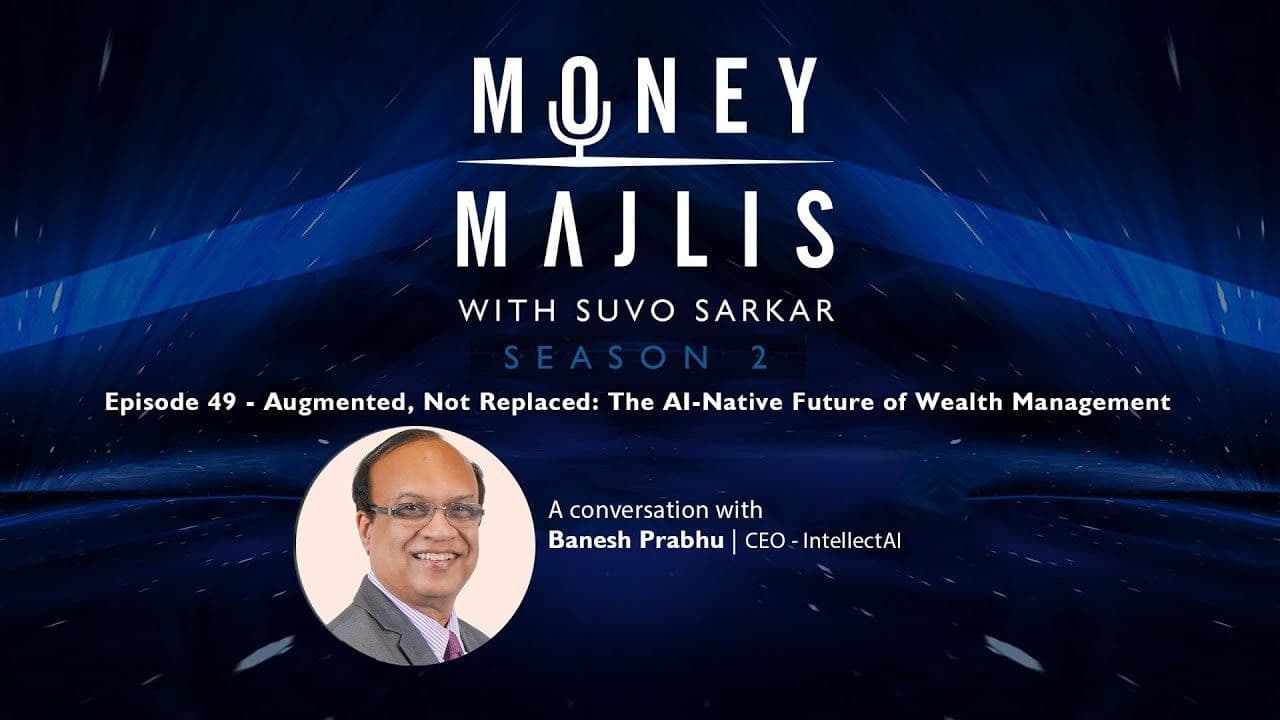
Guest bio
- CEO of IntellectAI, the AI and analytics business of the listed Indian fintech Intellect Design Arena.
- Spent about 23 years at Citibank, rising to global COO of the International Consumer Bank, serving around 50 million clients.
- Has been a senior adviser to Boston Consulting Group and a fintech investor and fund partner in the UK.
Banesh Prabhu is CEO of IntellectAI, the AI and analytics business of Intellect Design Arena, the listed Indian fintech that works with more than 500 financial institutions worldwide and builds AI-native platforms such as eMACH.ai and Wealthforce.ai for regulated institutions. He has more than three decades of senior global experience in operations, distribution and technology, including about 23 years at Citibank, where he rose to global COO of the International Consumer Bank, serving around 50 million clients in over 55 markets with more than 35,000 employees. He has been a senior adviser to Boston Consulting Group and a fintech investor and fund partner in the UK. He joined Intellect in 2016 as chief strategy officer and senior adviser, and since 2020 has led its insurance, wealth and capital markets business, now branded IntellectAI. He lived in Dubai in the 1990s.
Show notes
Private banking and wealth management are under intense pressure: rising regulation, demanding next-gen clients and thinning margins are forcing institutions to rethink how they work. In this episode of Money Majlis, Suvo Sarkar sits with Banesh Prabhu, CEO of IntellectAI to explore how AI can move from pilot to production - turning fragmented data into real-time intelligence for advisers, operations and risk teams. They debate what a truly AI-led wealth future looks like - from augmented relationship managers to agentic platforms that can orchestrate complex processes end to end.
Can AI can turn fragmented data across core systems, market feeds and unstructured documents into a “knowledge garden” that powers secure, domain-specific copilots for wealth teams? Instead of manually piecing together reports and call notes, can relationship managers walk into meetings with real-time, AI-curated insights on goals, risks, past interactions and next-best actions? That shift, if real, promises not only higher productivity, but more relevant and timely conversations in a business that remains deeply emotive and trust-based.
Suvo and Banesh unpack why the real battleground will be “trusted intelligence”, not raw intelligence. They discuss how audit trails, human-in-the-loop design and explicit governance layers around toxicity, bias and hallucination are becoming non-negotiable for regulators focused on suitability, consumer duty and fair outcomes. The future wealth winners, they argue, will be institutions that can industrialise AI use cases while still making it clear who is accountable when things go wrong.
For the GCC, Suvo and Banesh see a rare opening to build AI-native wealth hubs: less legacy, faster decision cycles, ambitious regulators and an influx of global wealth all create fertile ground for platform-led innovation. But they warn that success will depend on upgrading data maturity, cultivating new skills and resisting the temptation to bolt AI onto broken models instead of reimagining journeys around outcomes.
The episode also dives into leadership: building cross-cultural, cross-functional teams, moving from command-and-control to empowered “diamond-shaped” organisations, and why ruthless prioritisation, patience and people-first thinking are at the heart of any successful transformation.
If you want a realistic roadmap to AI-enabled, human-centric wealth management - grounded in what is working in large, regulated institutions today - this episode offers a concise, practitioner’s guide to the future.
Comments
Loading comments…