
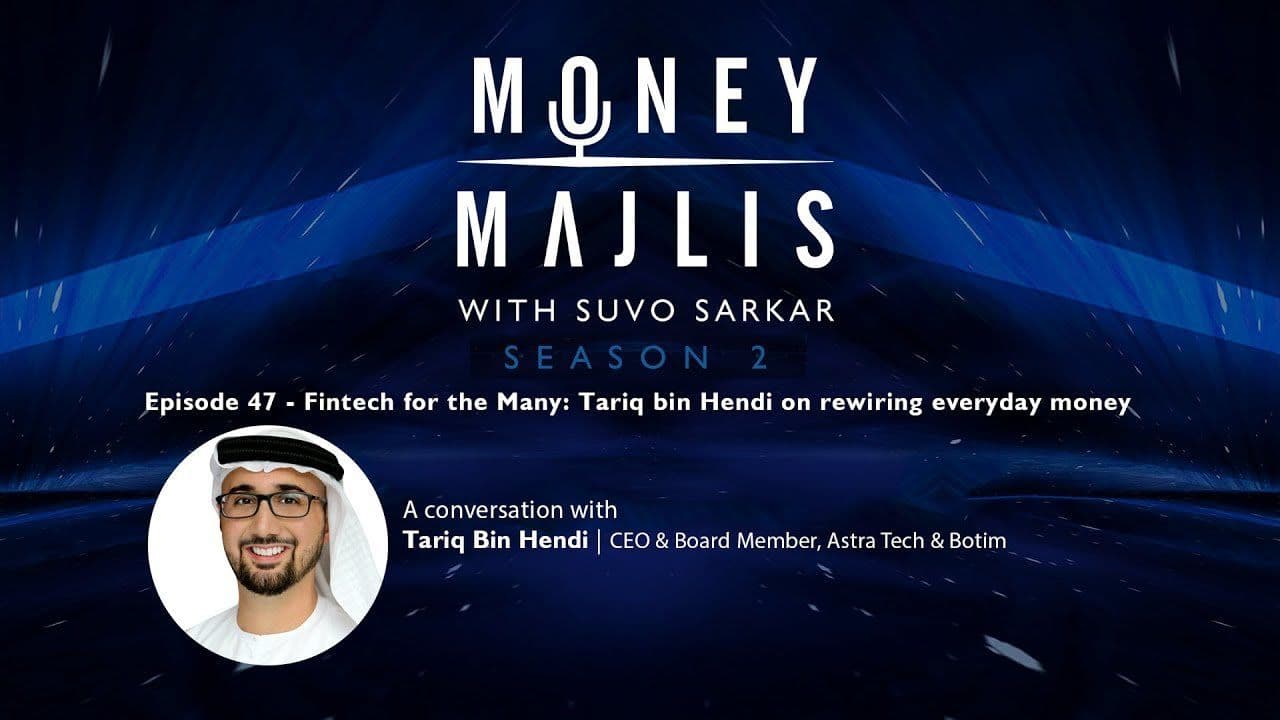
Guest bio
- Vice Chairman and CEO of Astra Tech, the parent company of Botim.
- Has overseen Botim's relaunch from a VoIP calling app into an AI-powered, fintech-first platform for more than 100 million users.
- Previously Director General of the Abu Dhabi Investment Office, and holds a doctorate from Imperial College London.
Tariq bin Hendi is Vice Chairman and CEO of Astra Tech, the parent company of Botim. His career spans wealth management at Emirates NBD, where he shaped the bank's wealth and asset management offerings; investment and innovation as Director General of the Abu Dhabi Investment Office, where he attracted foreign direct investment and pioneered public-private partnerships; and leading G42's rapid growth in AI. At Astra Tech he has overseen Botim's relaunch from a VoIP calling app into an AI-powered, fintech-first platform for more than 100 million users, adding Botim Money, micro-lending, instant cross-border payments and gold investment. He holds a doctorate from Imperial College London and MBAs from Columbia and London Business School, has worked in Dubai, Abu Dhabi, London and New York, and serves on boards and in advisory roles including G42, Edelman Middle East and Gulf Capital.
Show notes
In this episode of Money Majlis, host Suvo Sarkar sits down with former colleague Dr. Tariq bin Hendi, Vice Chairman and CEO of Astra Tech, to unpack how Botim is transforming from a simple VoIP calling app into an AI-native fintech powerhouse for the UAE and beyond. It is a conversation that weaves together policy, technology, inclusion, and leadership-anchored in one of the region’s most ambitious experiments in embedded finance.
Tariq begins by tracing his unconventional journey across investment banking, wealth management, government service and now consumer technology, and explains why the financial needs of a blue collar worker are fundamentally the same as those of a millionaire. That perspective underpins Astra Tech’s big bet on Botim: rebuilding the platform from the ground up as an AI-native ecosystem that combines communication, payments, lending, remittances and investments into a single everyday app. With over 100 million users globally and more than 3.5 million wallet customers in the UAE alone, Botim now sits at the crossroads of digital life and digital money in the region.
Suvo and Tariq dig into what it really took to re-architect Botim from a scattered set of brands to a unified financial-services-first platform. Tariq explains how the team rebuilt the tech stack, integrated payments and lending under one roof, and used AI to simplify user journeys for customer segments that are often excluded from sophisticated financial tools. He shares how Botim’s wallet now gives many underbanked users their first virtual IBAN, enabling wallet-to-wallet, wallet-to-bank and bank-to-wallet flows at some of the lowest remittance costs in the UAE, while also building credit histories that connect them to the wider financial system.
The episode also explores the human side of financial inclusion. Tariq talks candidly about understanding the realities of workers who still queue at ATMs for cash, and designing products that meet their real needs rather than just their “nice-to-haves.” From micro-lending and low-ticket gold investments to future features that will help families and children build savings and financial literacy, he outlines a roadmap that is commercial, but deeply social in its impact. Looking ahead, he predicts that AI-powered advice, hyper-personalised interfaces and frictionless, voice-led interactions will redefine how people across emerging markets experience money.
Beyond the product story, the conversation covers leadership, culture and resilience. Tariq reflects on creating a culture of accountability without fear, and the leadership traits that have carried him across banking, government and tech: honesty, execution, and the discipline to “listen to understand, not to respond.” He closes with practical career advice for young professionals and his obsession with collecting Lego blocks.
Comments
Loading comments…